Men's Curly Hair: Cuts, Barber Talk and a Simple Routine
In this guide
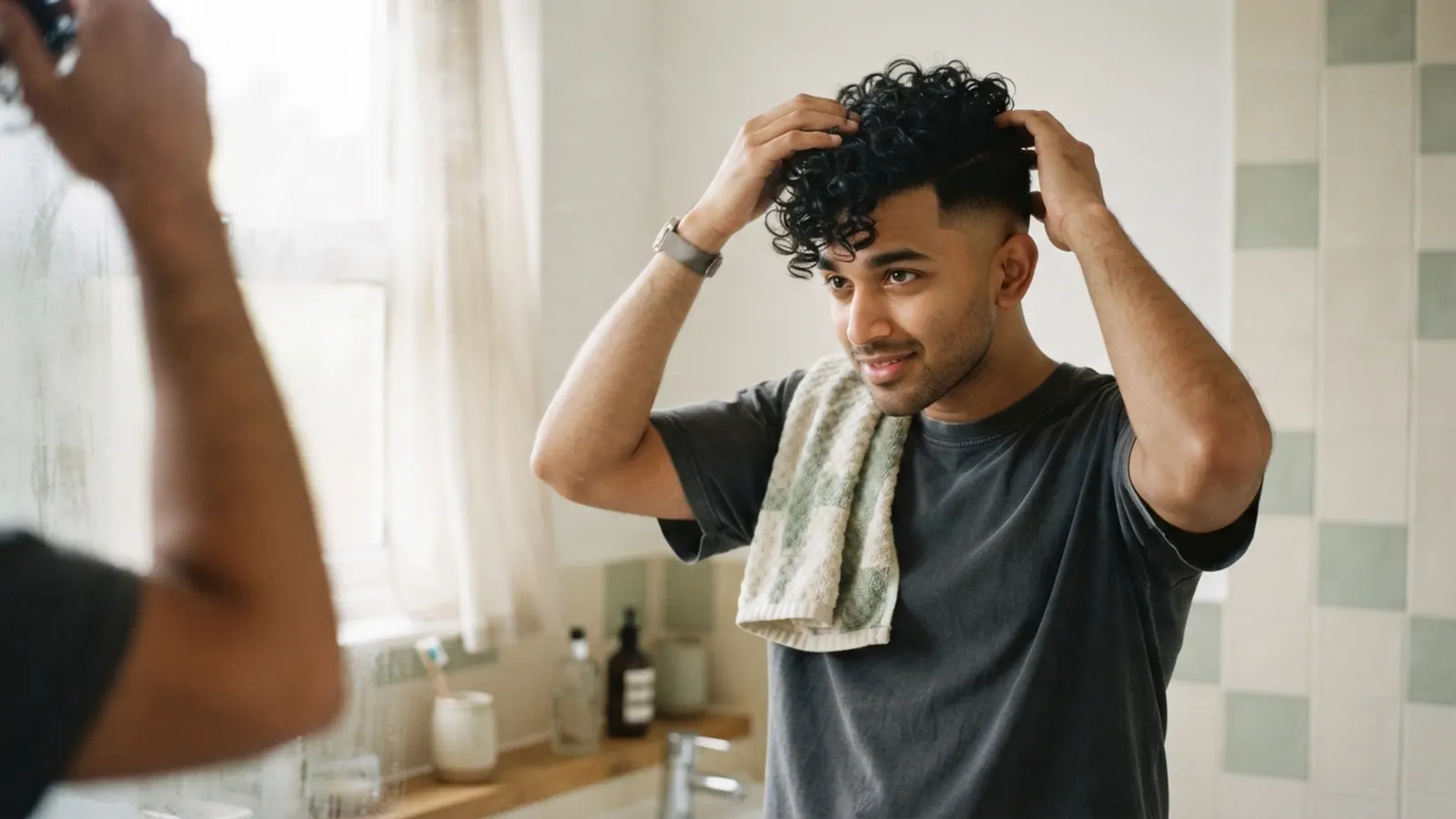
A lot of men with curly hair spent their school years at war with it. The barber thinned it out "to make it manageable". Mornings meant a blow-dryer, a comb and a fistful of gel to press it flat. By lunch it had puffed back up anyway.
If that's you, here's the thing nobody said at the time: the hair was never the problem. The cut and the routine were built for straight hair, and curls punish that.
Men's curly hair is actually low-effort once you stop fighting it. You need a cut shaped for curls, a barber who won't thin it, and about three products. That's most of it.
First, figure out what you're working with
You'll see curl "types" online, numbered 2 to 4 with letters. You don't need to grade yourself that precisely. Three rough groups are enough:
Wavy. Loose S-bends. Looks straight-ish when brushed, goes fluffy in humidity.
Curly. Clear spirals or ringlets, anywhere from loose loops to pencil-width. Bulky, springy, dries out fast.
Coily. Tight coils or zig-zags, dense, and it shrinks a lot when dry. A coil that looks 2 cm long might stretch to 6 cm.
Most heads mix them. Go by what the top does, since that's what you'll style.
Cuts that work with curls
The common failure is the triangle: sides puffing outwards, top sitting low, the whole head getting wider towards the bottom. Almost every good curly cut fixes this the same way, by keeping the sides tight and letting the top carry the curl.
The curly top fade
If you're unsure, start here. A low or mid fade on the sides, going from a zero or one up to a two, and 2 to 3 inches (5 to 7 cm) of curls left on top. The sides stay neat for weeks, the top gets all the attention, and it works on wavy, curly and coily hair alike.
In the chair: "Mid fade, zero to two on the sides. Leave about two and a half inches of curl on top, shape it dry, and please don't thin it."
If you want the sides less severe, swap the fade for a taper and only the edges get short. Our fade guide explains every height if you want to pick more precisely.
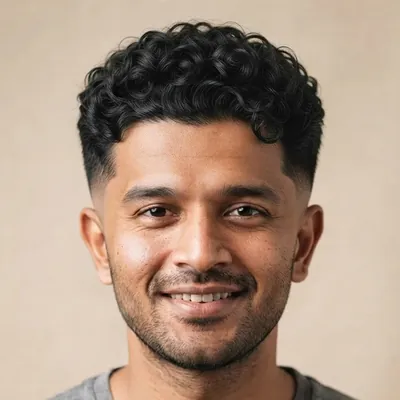
A short curly crew cut
About an inch on top, number two or three on the sides with a taper at the neck. The curl stays as short, tight texture instead of full spirals. There's genuinely nothing to style. Wash, towel off gently, done.
It's the cut for men who want curls to stop being a project, and the most forgiving in July humidity. More short options are in our roundup of short haircuts for men.
Medium curls with scissor-cut sides
Three to four inches on top, scissor-cut sides, tapered neckline. Curls show their full pattern. Best on wavy and loose curly hair; on tight coils it can turn into a helmet.
Tell the barber: "Scissors on the sides, taper the neckline, keep three to four inches on top, and cut the curls dry, one by one if you can."
For coily hair: high top or twists
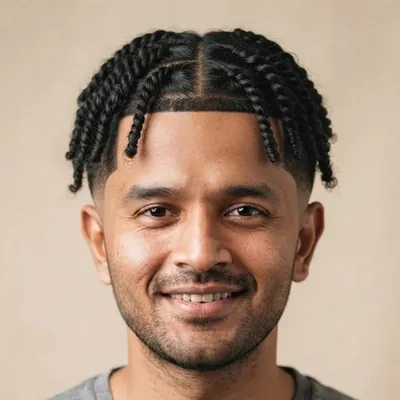
A high top is a skin or low fade on the sides with a tall, flat-topped block on top. It needs a barber who can pick out and shape the hair evenly, so ask before they start. Two-strand twists take 3 to 4 inches on top in small sections, with a low taper and a clean line-up, and hold for days.
What to tell the barber
This part matters more than the cut name.
Ask for a dry cut, or at least a dry finish on top. Curly hair shrinks as it dries, sometimes by half. Soak it, comb it straight and cut to a length, and far more comes off than either of you meant. Cut dry, the barber sees each curl where it actually sits.
Say "no thinning" before they start. Thinning shears or a razor cut random hairs short inside each curl. The short bits pop out of the curl and you get frizz and a fuzzy outline. On thick straight hair, thinning can help. On curls, it's how most of the "unmanageable hair" stories began. In a lot of Indian shops thinning is so routine that the barber won't ask, so say it in the first sentence: "Thinning mat karna, please."
No combing it out at the end. A fine-tooth comb through dry curls turns them into a cloud.
Not every barber is good with curls. Ask: "Do you cut much curly hair?" A confident yes is a good sign. Our post on what to say at the barber has the full order to say things in.
Before you go, it helps to see the cut on your own head. CheckMyHairstyle previews styles like the curly top fade on your selfie, and gives you a barber card with the sides, top and finish written out in English and Hindi, including the "no thinning" note.
A wash and product routine that isn't a project
Online curl routines run to ten steps and seven products. You don't need them.
Wash less. Daily shampoo strips the oils curls rely on. Wavy hair does fine with shampoo two or three times a week. Curly hair, twice. Coily hair, once a week, with plain water rinses or conditioner-only washes in between. On off days, just wet your hair under the shower and add a little leave-in.
Shampoo your scalp, condition your lengths. Use a gentle, sulphate-free shampoo and rub it into the scalp only. Then put in more conditioner than feels sensible, and detangle with your fingers or a wide-tooth comb while it's still in. That's the only time a comb touches your hair.
Style while it's soaking wet. Not towel-dry, wet. Products go on in the shower or right after, then you scrunch upwards and leave it alone.
Dry gently. Squeeze water out with an old cotton T-shirt or a microfibre towel, never a rough towel rubbed back and forth. Then air-dry, or use a diffuser attachment on low heat and low speed. Don't touch it while it dries. Every touch breaks up the curl clumps.
Now the products. Think in types, not brands: any decent one of the right type will do. Start with whatever is easy to buy and give it a week or two before switching.
| Your hair | Moisture | Hold | Optional | Skip |
|---|---|---|---|---|
| Wavy | Light leave-in spray | Mousse or a light gel | Nothing | Heavy creams, butters |
| Curly | Curl cream | Medium-hold gel | A few drops of oil on the ends | Matte clay, dry shampoo |
| Coily | Rich leave-in or cream | Gel or curl custard | Oil or shea butter to seal | Alcohol-heavy gels |
Two things on that table surprise people.
Gel is good. A gel without much drying alcohol holds the curl shape while the hair dries. It will feel crunchy at first. That stiff layer is called a cast, and you want it. Once your hair is completely dry, scrunch it with your hands, maybe with a drop of oil on your palms, and the cast breaks into soft, defined curls.
Matte clay is bad, at least for curls. It's made for short straight cuts. On curly hair it soaks up moisture and leaves things dry and frizzy. Same goes for 2-in-1 shampoo, which doesn't condition enough.
On the label, look for water and moisturisers near the top, and drying alcohols ("alcohol denat.") low down or absent.
If you only buy one thing, buy a curl cream or leave-in conditioner. Moisture fixes more curly hair problems than any other product.
Humidity, monsoon and hard water
Humid air is why curls look great at 9 a.m. and twice the size by noon. Dry hair pulls water out of the air and swells. Two things help.
Keep the hair moisturised so it's less thirsty. A leave-in every wash, and a conditioning mask once a week for curly and coily hair.
Use a bit more hold in the humid months. If a light gel works in winter, step up to medium hold from June to September, or layer a little gel over your curl cream. The cast keeps the outer frizz down until the air dries out.
Hard water, common in a lot of Indian cities, leaves a dull, stiff film on curls over time. If your hair feels rough even after conditioning, use a clarifying shampoo every couple of weeks, then a proper conditioner, since clarifying dries hair out.
At night, a satin or silk pillowcase cuts friction, so you wake up with fewer frizzy, flattened patches.
And keep the cut on schedule. A curly top fade looks sharp for two to three weeks before the sides start to puff. Our guide to how often men should get haircuts breaks down timing by style.
Quick answers
My hair is wavy, not really curly. Does any of this apply?
Yes. Wavy hair is the most likely to have been brushed straight for years, so it often looks less wavy than it is. Try a light leave-in and mousse on wet hair, no touching while it dries, for two weeks. A lot of "straight-ish" hair turns out to be wavy.
What if my barber thins it anyway?
Ask calmly before the next cut, and if it keeps happening, find another barber. Thinned curls usually take a cut or two to settle back, because the short pieces need time to grow back out to the length of the rest.
Try these on your face
- Curly Top FadeSee it on you
 Crew cutSee it on you
- Two-Strand TwistsSee it on you
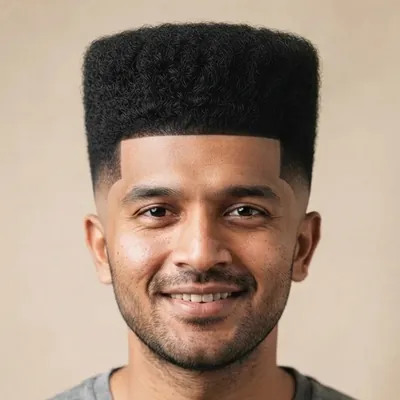 High TopSee it on you
Keep reading

What to Say at the Barber to Get the Haircut You Actually Want
The words barbers use, a simple order to say things in, how to use a photo properly, what to do when it goes wrong, and tipping in India, the US and the UK.
Read the guide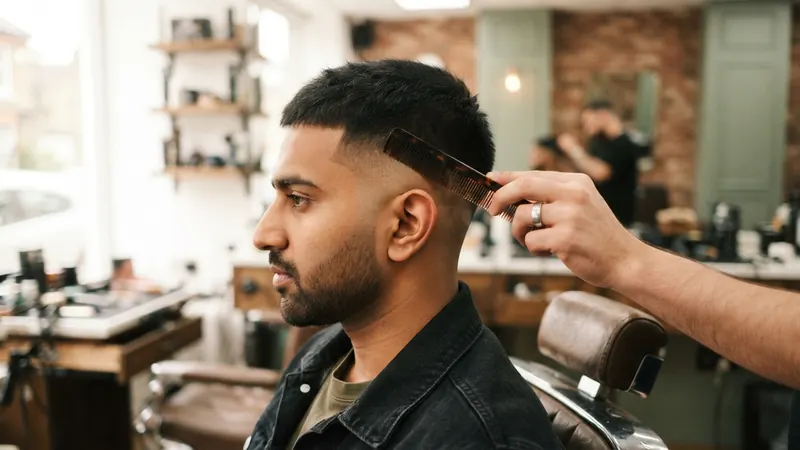
Fade Haircuts for Men: Every Type, and What to Tell Your Barber
Low, mid, high, skin, taper, drop and burst fades in plain words, with clipper numbers in mm, which one suits you, and the exact sentence to say in the chair.
Read the guide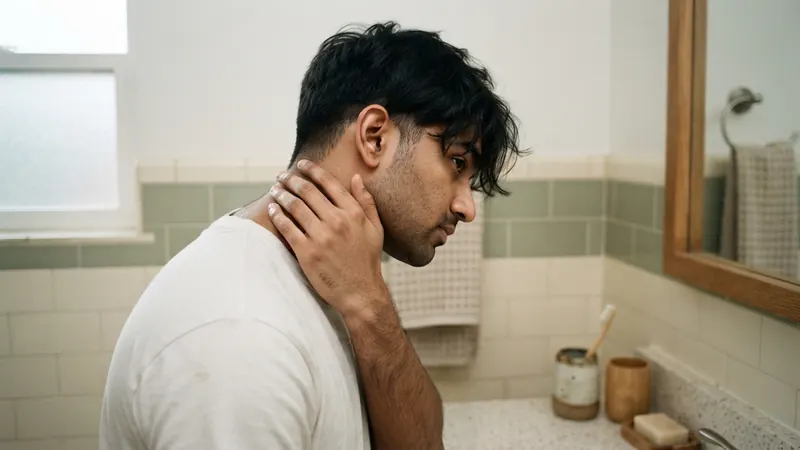
How Often Should Men Get a Haircut? A Schedule by Style
Skin fades every two weeks, crops every month, longer cuts every two months. A schedule by style, the signs you're overdue and how to buy an extra week.
Read the guide