Haircuts for Round Faces (Men): What Works, What Doesn't
In this guide
If you've ever got a haircut that looked great on the guy in the photo and somehow made your face look wider, there's a decent chance your face is round. That's not a problem. It just means a few haircuts will do a lot for you, and a few others will quietly work against you.
The idea behind every good haircut for a round face fits in one line: height on top, less on the sides. The rest of this post is just how to do that with your hair.
First, check that your face is actually round
Lots of men decide they're "round" after one bad photo. Before you change your haircut around it, check.
Pull your hair off your forehead and look straight into a mirror, or take a selfie at eye level. Then look at two things.
Length vs width. If your face is roughly as long as it is wide, with the widest point at the cheeks, you're in round territory. If it's clearly longer than it is wide, you're more likely oval.
The jaw. Run a finger along your jawline below the ear. A curve means round. A corner means square. Round and square faces have similar proportions, but square faces already have the angles that round ones are missing, and that changes what suits you.
Why height and short sides work
A round face is widest at the cheeks, and about as long as it is wide. A haircut can change how those proportions read in two ways.
Volume on top makes the outline of your head taller, so your face reads longer. Short sides (a taper or a fade) stop the hair adding bulk right next to your cheeks, where you're already widest.
Angles help too. A side part, a fringe swept to one side or a crisp hairline all add straight lines next to soft curves. That's it. Every cut below follows that idea in some way.
The cuts we'd try first
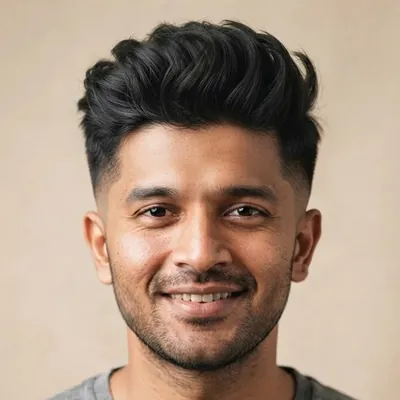
Textured quiff
If we had to pick one, it would be this. The front is long and lifted, it gets shorter towards the crown, and the sides are faded. The messiness helps: texture reads as height.
Ask for: low fade on the sides, from a one up to a three. Leave three to four inches at the front, shorter towards the crown, heavily textured. Blow-dry it up and finish with a matte paste.
Pompadour
More height than a quiff, and smoother. It needs hair that's straight or wavy and thick enough to hold volume. Thick Indian hair is usually perfect for it. The catch is about five minutes with a hairdryer every morning. Be honest with yourself about whether that's going to happen.
Ask for: short tapered sides (a two or three) or a mid fade. Three to four inches at the front, shorter towards the crown, with a side part.

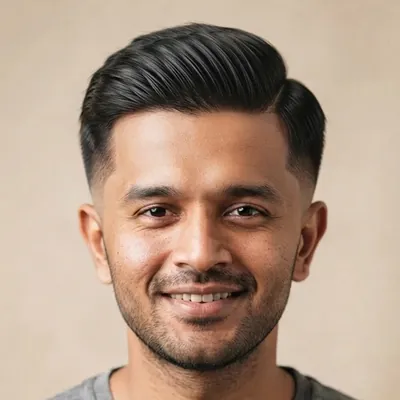
Side part, with a bit of lift
The office-friendly option. The diagonal parting line breaks up the roundness, and sweeping the hair to one side adds some useful asymmetry. The one thing to avoid is combing it flat against your head. Flat is the version that doesn't work. Ask for a little lift at the front.
Ask for: a number three taper or scissors on the sides, neat over the ears, and two and a half to three inches on top.
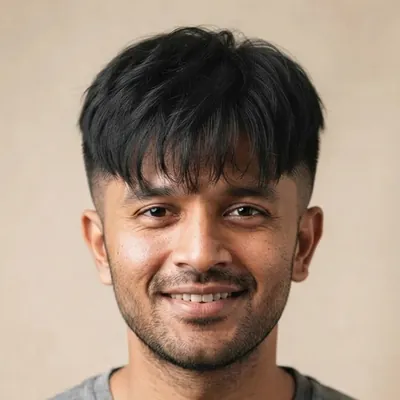
Two-block cut
If your hair is straight and you want something more current, the Korean two-block puts all the visual weight on top. For a round face, style the fringe up or to one side rather than straight down onto your forehead.
Ask for: undercut on the sides and back with a one or two, up to the temple line, no blend into the top. Two and a half to three inches on top, point-cut.
Taper fade with a short textured top
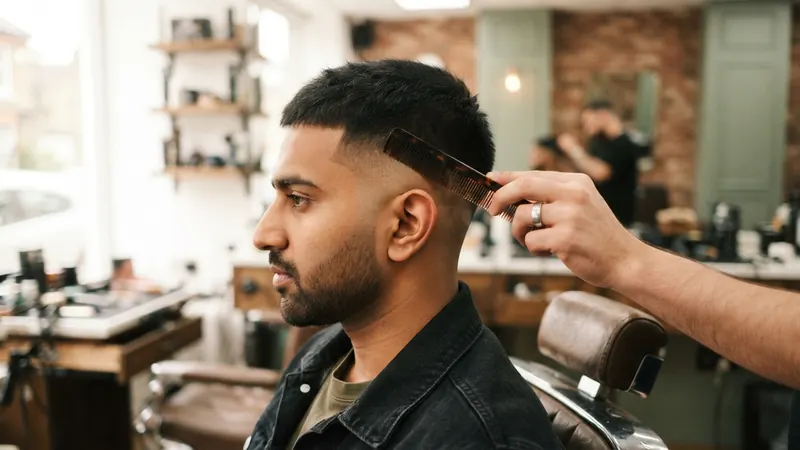
Want short and easy? A taper fade with an inch and a half to two inches on top still gives you enough to push up a little, and the tight sides do the slimming. A mid fade slims more than a low one. Our guide to fade haircuts explains the heights.
Cuts that work against a round face
None of these are banned. They're just harder work for you.
Heavy, straight fringes and bowl cuts. A flat horizontal line across the forehead makes the face look shorter, and therefore wider.
The same length all over at medium length. Hair sitting evenly on the sides adds bulk exactly where you don't want it.
Chin-length hair. It ends at the widest part of your face and draws the eye straight there.
A very short buzz cut with no beard. A buzz follows the shape of your head and face exactly, so it shows the roundness rather than balancing it. With a beard that's longer at the chin, it can absolutely work.
Curly or thick hair
Curly hair grows outward, which adds width. Same fix, though: keep the sides short (a mid or high fade) and leave two to three inches of curls on top so the volume goes up, not out. Ask for the curls to be shaped dry, and use a curl cream instead of brushing them out.
If your hair is fine or thinning, go shorter on top, around two inches, with a matte product for texture. Long, fine hair falls flat and adds nothing.
Let a beard draw the jawline
A beard is the easiest way to add a jawline you don't naturally have. The trick is length at the chin and less at the cheeks.
- Keep the cheeks shorter than the chin, say 5–6 mm on the cheeks and 10–12 mm at the chin.
- Leave the cheek line natural and fairly high. A low, sharp cheek line widens the face.
- Trim the bottom to a slight point or a squared edge rather than a round curve.
- Set the neckline about a finger above your Adam's apple, so the beard sits along the jaw rather than under it.
Heavy stubble cleaned up at the neck, a short boxed beard or a goatee with stubble all work.
Before you go
Two men with round faces can still look completely different in the same haircut, because hairline, hair thickness and ears all play a part. That's why we built CheckMyHairstyle: upload a selfie, try a quiff, a pompadour and a two-block on your own face, and walk in knowing which one works. Each preview comes with a barber card you can show in the chair, in English and Hindi.
When you get there, be specific: the style and a photo, the clipper number for the sides, how much to leave on top, and "I want height on top and the sides tight". Our post on what to say at the barber has the full script.
Try these on your face
- Textured quiffSee it on you
- PompadourSee it on you
 Side partSee it on you
 Two-block cutSee it on you
Keep reading
Fade Haircuts for Men: Every Type, and What to Tell Your Barber
Low, mid, high, skin, taper, drop and burst fades in plain words, with clipper numbers in mm, which one suits you, and the exact sentence to say in the chair.
Read the guide
What to Say at the Barber to Get the Haircut You Actually Want
The words barbers use, a simple order to say things in, how to use a photo properly, what to do when it goes wrong, and tipping in India, the US and the UK.
Read the guide